What separates a good event from an unforgettable one is rarely the budget. It is the alchemy — the precise meeting of design, logistics, and atmosphere that turns a room into a memory. Anyone can rent a venue and fill it with people. Far fewer can walk into a blank, echoing space and leave it transformed into something guests will still be describing a year later. That transformation is a discipline, and it is the discipline Afroboujie has built its name on.
The team describes itself as creative visionaries, logistical masterminds, and style-savvy tastemakers, and each of those three roles matters. The visionary imagines what the room could be. The mastermind makes it possible. The tastemaker makes it beautiful. Most event companies lead with one of the three. Afroboujie leads with all of them, which is why the work reads as coherent rather than assembled — every detail in conversation with every other detail, the room speaking in a single voice rather than a committee of vendors each shouting their own.
This is the curtain pull. What follows is the actual process behind the glitz and glamour, the portfolio that proves it, and the philosophy that keeps the work from ever becoming generic. For the engaged couple planning the wedding, the corporate lead staging the gala, and the host who simply refuses to settle, this is how Afroboujie does it, and why the rooms the team produces feel less like events and more like worlds.
The Art of Curation
It helps to draw the line that most of the industry blurs. Event planning is the logistics — the timelines, the vendors, the permits, the flow. Event design is the vision — the aesthetic concept, the mood, the story the room tells. A planner ensures the night happens. A designer ensures the night means something. Afroboujie does both, and the refusal to split the discipline is the root of the work's consistency. When the same mind that designs the room also engineers its logistics, the design is never compromised by a feasibility the designer didn't know about, and the logistics are never blind to a vision the logistics team wasn't told.
The brand's organizing conviction is the commitment to curating fun, brave, cultural spaces for People of African Descent. Every word in that mission is load-bearing. Fun, because joy is not frivolous for a community that has had to fight for the right to celebrate. Brave, because the rooms are unapologetic in their cultural specificity rather than diluted for a generic middle that pleases no one fully. Cultural, because the work is rooted in the true story of the community rather than borrowed from someone else's aesthetic. And spaces, because the goal is not a product but an environment — a place a person steps into and feels, before anything is said, that they belong.
That conviction is what distinguishes an Afroboujie room from a well-decorated room. The design is never decoration for its own sake; it is storytelling. A tablescape is not a floral arrangement; it is a thesis. A lighting plot is not illumination; it is atmosphere engineered for a feeling. The process that follows is how that thesis gets built, tested, and delivered, and it is the same process whether the guest count is eighty or eight hundred.
The Afroboujie Event Portfolio
The proof is in the rooms already produced, and a few deserve the close read.
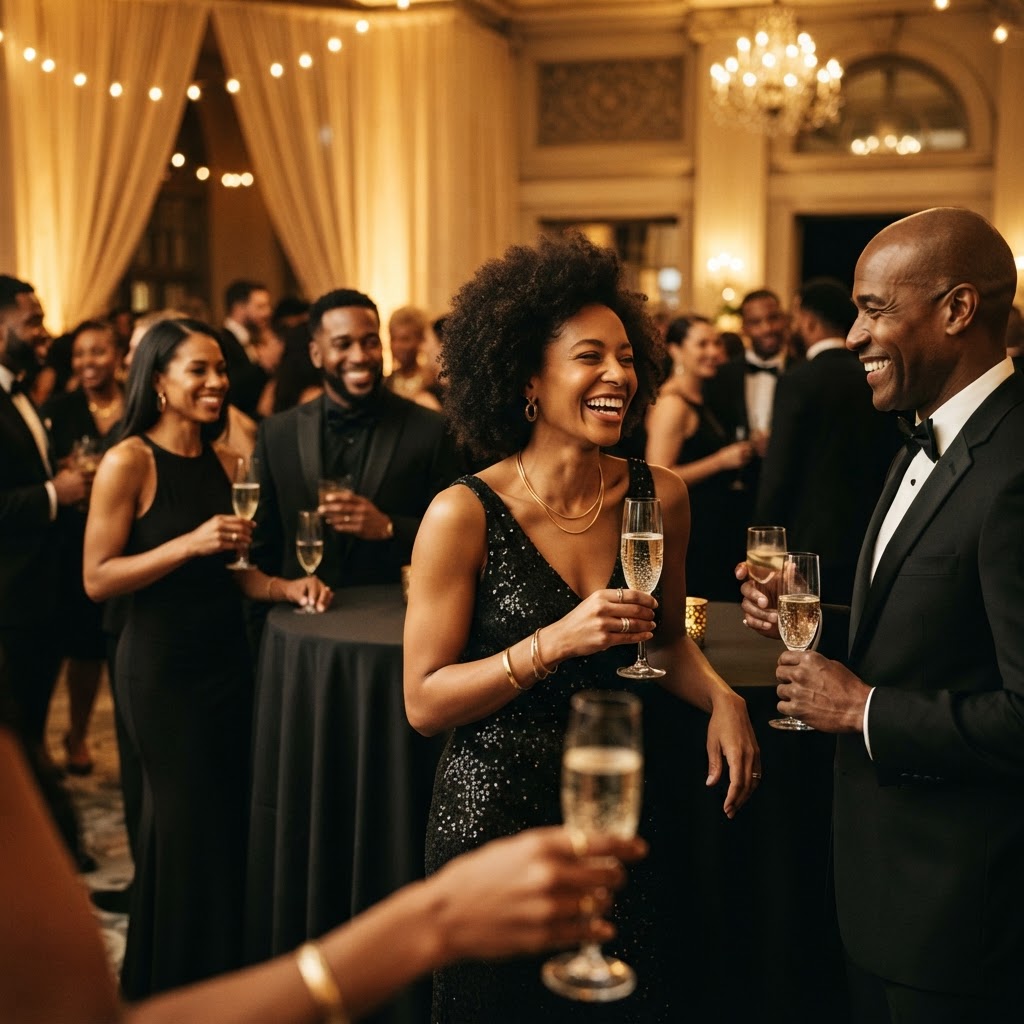
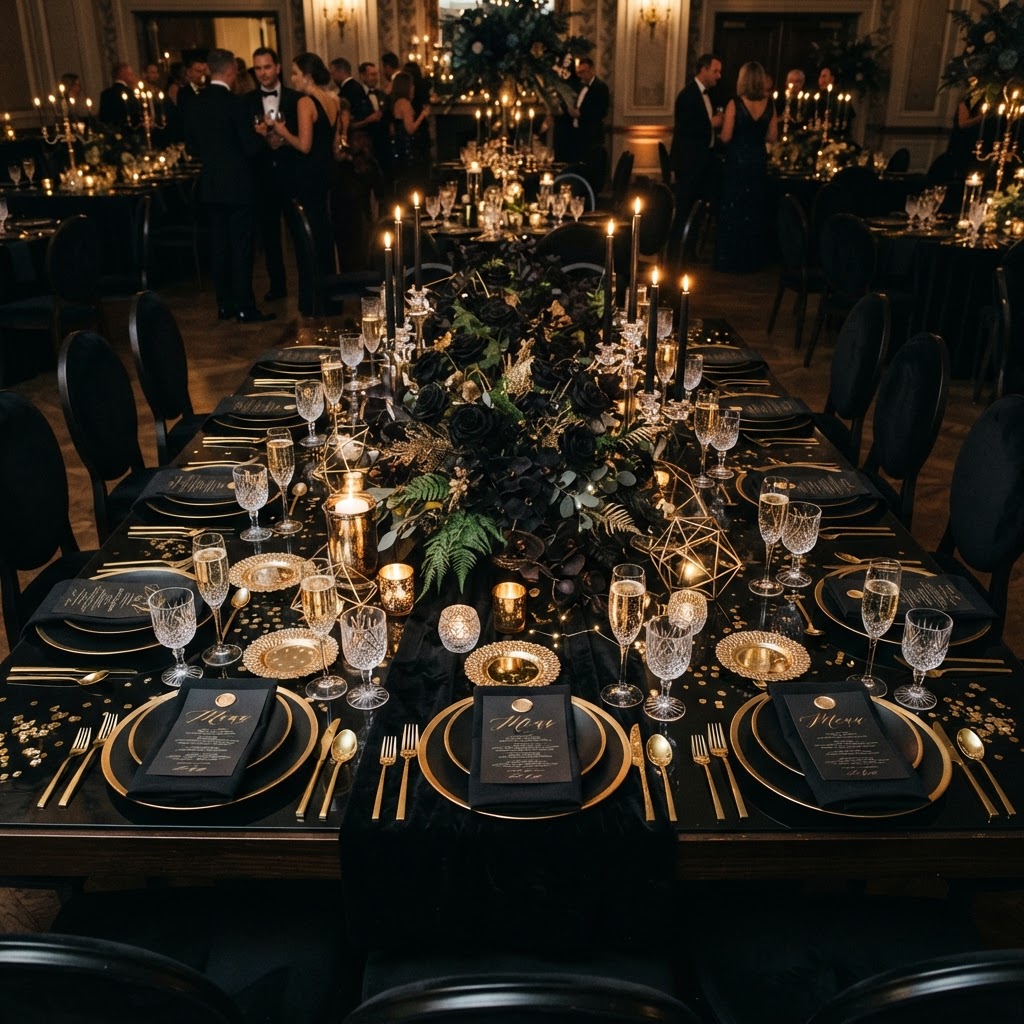
The flagship is the Annual All Black Afroboujie Party, held at The Rink Studios in Sacramento. The venue is industrial chic by nature — high ceilings, raw concrete, the bones of a space that can become anything. Afroboujie transforms it into a glitzy, glamorous wonderland through the disciplined application of a single idea: everyone in black. The dress code is not a suggestion but a standard, and its enforcement is what creates the visual coherence that makes the room photograph unlike any other in the region. Against the uniform black, the gold of the bottle service, the warmth of the lighting, and the movement of the crowd read at full intensity. It is the same room, but it is not the same room, and the guests who arrive skeptical leave converted.
Then there is Le Diner En Blanc Sacramento, the local edition of a global phenomenon defined by strict elegance and secrecy — guests dressed entirely in white, a location revealed only at the last moment, a pop-up dinner that appears and disappears in a single evening. Afroboujie's involvement demonstrates a capability the industry rarely tests: high-stakes logistics under genuine secrecy. Coordinating hundreds of guests, a full table-setting operation, and a complete teardown with no rehearsal and a location disclosed hours before doors is a logistics problem most producers would refuse. Afroboujie takes it on because the discipline it demands is the same discipline the team applies to everything else, only compressed. If you can produce a secret pop-up dinner, you can produce a wedding, and the calm is transferable.
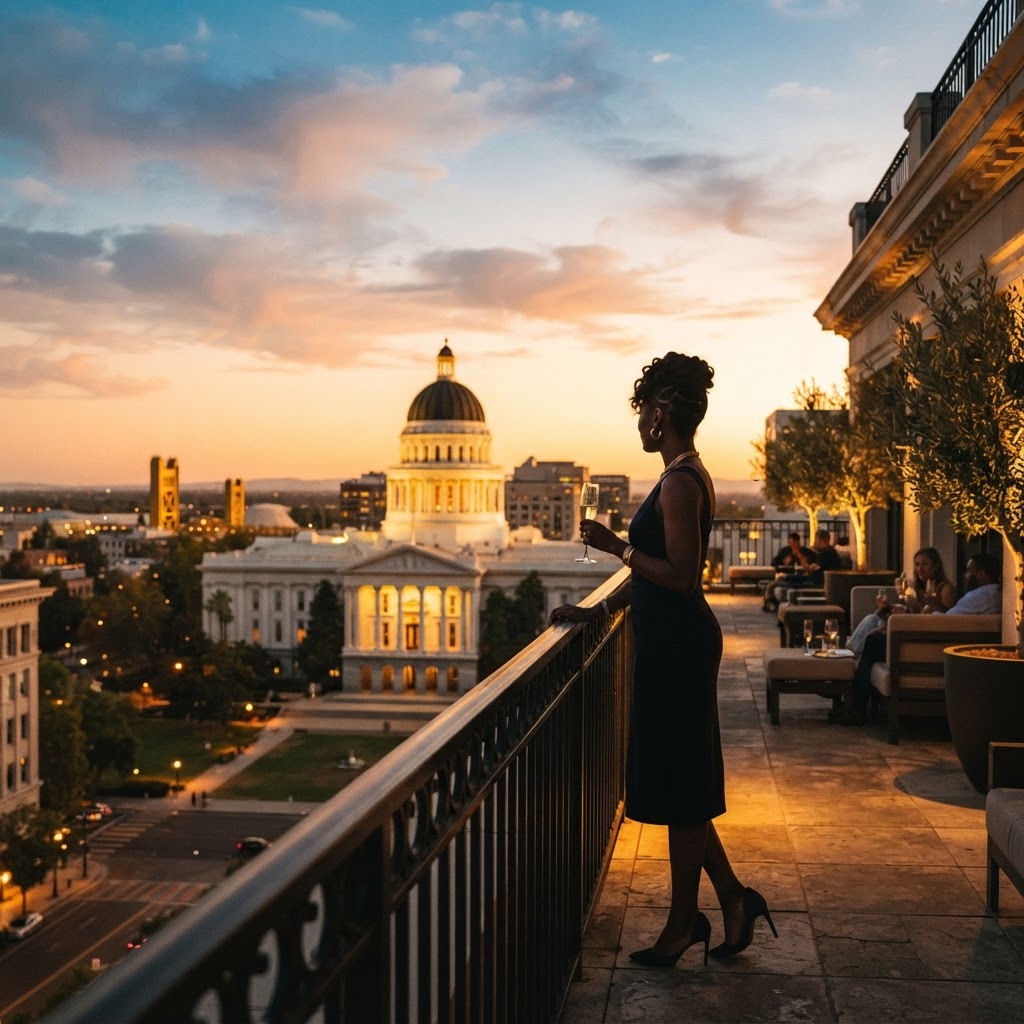
And the work is not bounded by Sacramento. Afroboujie produces upscale Afrocentric events on a global scale, including pop-ups in Ghana during Detty December — the month-long diaspora celebration that draws the world to Accra each December. The same standard that governs a Sacramento gala travels. The team that curates a room in California can curate a rooftop in Accra, and the throughline is the team's design language, not the venue's geography. That portability is the real test of a design philosophy: does it survive a change of continent? For Afroboujie, it does, and the proof is the diaspora travelers who recognize the Afroboujie signature on a Ghana rooftop without being told who produced the night.
The Design Process: From Vision to Reality
The process behind every Afroboujie event runs in four phases, and the discipline of the phases is what keeps the work from drifting.
Phase One: The Vision Session
Before a single swatch is selected, the team sits with the client for a vision session, and the goal is not to collect a mood board but to recover a story. Who is this event for? What is the cultural narrative the room should carry? A wedding is not a wedding; it is the union of two families and, often, two or more cultural lineages that deserve to be honored on the plate and in the room. A gala is not a gala; it is an organization's public statement about who it is and what it values. The vision session is where Afroboujie learns what the event is actually about, and the entire design is then built to say that thing out loud, in a room, without a word being spoken.
Phase Two: Venue Selection
The venue is the first and most consequential design decision, and Afroboujie works with a portfolio of premier Sacramento spaces chosen for their range. The Citizen Hotel offers historic elegance — chandeliers, grand staircases, the gravitas of a landmark that signals the evening's weight the moment a guest walks in. The Rink Studios offers industrial chic — the blank canvas that rewards bold transformation and lets a design concept run without competing architecture. The selection is never about the venue's reputation; it is about the match between the venue's bones and the event's story. The wrong venue can be decorated around but never fully corrected, so the team treats selection as design, not logistics.
Phase Three: The Transformation
This is where the logistical masterminds earn their name. Once the vision and the venue are set, the transformation is engineered with grids, floor plans, and timelines that would satisfy a stage director. Traffic flow is mapped so a room of three hundred never bottlenecks at the bar or the photo wall. Lighting is plotted to carry the eye where it should go and away from where it should not, with layered washes that shift across the evening as the energy builds. Every vendor arrives on a schedule sequenced to the minute, and the load-in is rehearsed in advance on paper so the actual day is execution, not improvisation. The guest never sees this layer, and that is the point. A flawless event is one in which the labor is invisible and only the experience remains.
Phase Four: The Sparkling Tablescapes
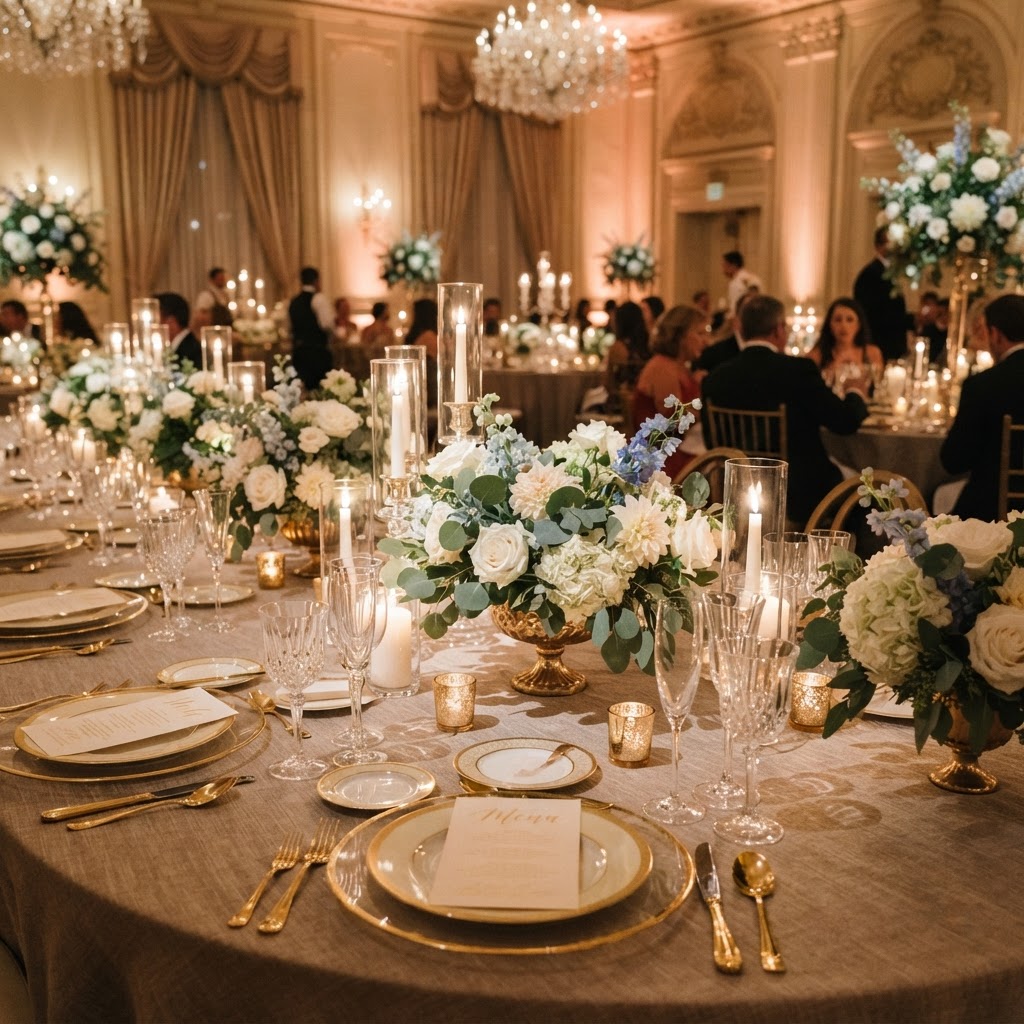
The final phase is the visual payoff, and it is where Afroboujie's signature lives. The tablescapes are not set; they are designed. Cultural elements are woven in with restraint — a subtle Ankara print on the napkin ring, a runner that references kente without costume, local blooms chosen for color story rather than convenience. The goal is resonance, not reproduction. Done badly, cultural decor tips into kitsch; done well, it reads as intention, and guests feel the room as a continuation of their own story rather than a theme imposed on it. From secret locations to sparkling tablescapes, Afroboujie handles everything, and that end-to-end ownership is precisely what allows the details to cohere. The same hand that chose the venue sets the last fork, and the continuity shows in every frame of the photography.
Cultural Storytelling Through Design
The hardest part of culturally specific design is the line between homage and kitsch, and Afroboujie walks it deliberately. The principle is simple: infuse, do not costume. A room should carry the aesthetics of the African diaspora the way a well-tailored garment carries a fabric — as structure, not applique.
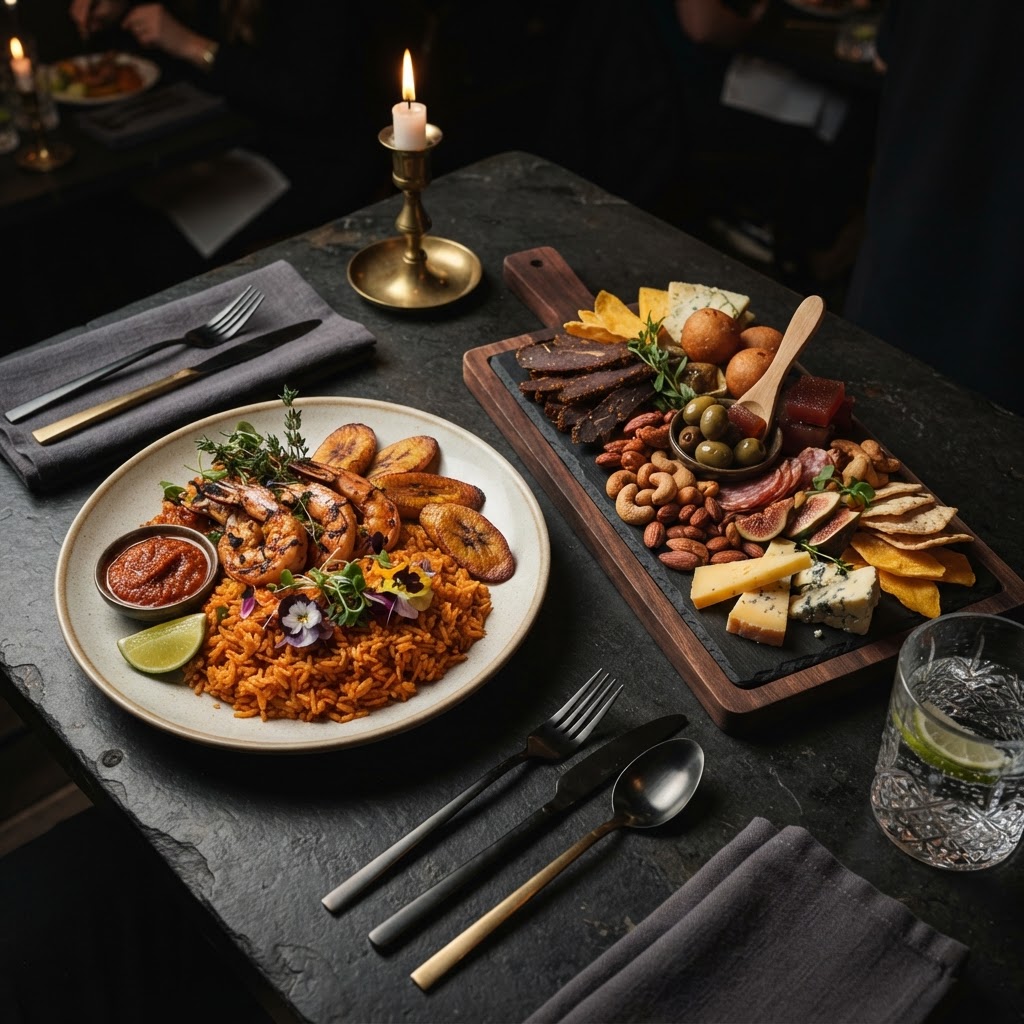
In practice that means kente-inspired patterns used as accent pieces rather than draped over every surface. It means incorporating Afro-Caribbean flavors into the catering so the menu tells the same story the decor is telling, the food and the room in conversation. It means selecting music that arcs through the evening with intention — a setlist that moves through the diaspora's sound so that a single night can carry a listener from Lagos to Kingston to Sacramento and back. Every element is chosen because it contributes to a thesis the team has already written, and the thesis is always some version of championing the true story of our community.
The reason this matters is that the alternative is erasure by dilution. The generic, culturally unmarked event is not neutral; it is a choice to make the room legible to everyone by making it specific to no one. Afroboujie's rooms are specific, and the specificity is what makes them memorable. A guest does not leave a culturally unmarked ballroom with a story to tell. A guest leaves a room that was unapologetically itself with a story they will retell for years. That is the business case for cultural storytelling in design, and it is also the moral one.
Corporate Events: Elevating Brand Experiences
The same discipline serves the corporate client, and increasingly it must. A modern corporation hosting stakeholders, clients, or its own workforce cannot afford the generic event that signals nothing. Culturally competent events are no longer a nice-to-have; they are how an organization demonstrates that it understands the room it is in and the people in it.
Afroboujie's corporate work applies the same four-phase process to a different outcome. A product launch becomes a cultural moment rather than a presentation. A client appreciation dinner becomes an experience that says something about the host's standards before the first course arrives. An end-of-year celebration becomes the evening that retains talent through the next quarter. A concrete example: using Afro-Caribbean-infused catering to impress a diverse set of stakeholders does not just feed them — it signals, before the first course, that the host sees them. In a city and a region as diverse as Sacramento, that signal is competitive advantage.
The business case is measurable in the way the room lands. Culturally sophisticated events generate the kind of word-of-mouth that marketing budgets cannot buy, because a guest who felt genuinely seen tells other people, and those people arrive at the next event already primed to trust the host. Afroboujie's corporate portfolio is built on this loop: design the room well, let the guests become the ambassadors, and let the events compound into reputation.
Conclusion: The Afroboujie Signature
What makes Afroboujie different is not any single element. It is the integration. The creative vision, the logistical mastery, and the stylistic sensibility are not three services bolted together; they are one practice expressed in three registers. The result is the work the team is proud to call its own: curators of elegance, community, and unforgettable moments.
For the couple planning a wedding that honors two lineages, the executive staging a gala that has to land, and the host who has decided that the next gathering will be the one people remember, the invitation is direct. Bring Afroboujie the vision, and the team will bring the room to life — from the first secret location to the last sparkling tablescape. Contact Afroboujie for a consultation, and start with the conversation that every unforgettable event begins with: the one about what the night is actually for.